
FND support by telehealth, Australia-wide
Support for FNDincluding functional seizures
Your symptoms are real, and recovery is possible.
Functional Neurological Disorder (FND) is a problem with how the brain and body communicate. The brain’s structure is intact, but the way it works has changed. We start with a holistic assessment of your needs and build a recovery plan together. Get a clear explanation of what's happening in your nervous system, and practical skills to retrain it, from your own home.
What we help with
Functional weaknessTremor and jerksWalking changesFunctional seizuresSensory symptomsDizzinessBrain fog and memoryFatigueDysautonomia and POTSME/CFS
Dysautonomia and ME/CFS often overlap with FND, and can also be supported on their own.
Understanding FND
FND is real. It’s common. And you can recover.
FND is more common than many well-known neurological conditions, and the second most common reason for referral to a neurologist, after headache and migraine. Yet most people have never heard of it. With the right support, people can and do recover, some of them fully, and it’s never too late to start.
Sources: Finkelstein et al., 2025; Fobian and Elliott, 2019.
Why does FND happen? Think of a river.
Your nervous system can only hold so much. When too much pours in, it spills over as symptoms.
What pours into the river
- The clouds are stressors on your nervous system, such as stress, poor sleep, injury, trauma, money worries and sensory sensitivities. They add up.
- The overflow is when your nervous system can’t cope, and functional symptoms appear.
- The sandbags are treatment, such as education, exercise, regulation and sensory retraining.
River analogy adapted from Re-Active Education.
Symptoms vary from person to person
FND looks different for everyone. These are some of the most common symptoms.
Fatigue, pain and poor sleep often come with it, and most people have more than one symptom.

Free guide
Wondering how FND is diagnosed?
Our free guide explains the positive signs doctors look for, who to see for a diagnosis, and why you can start therapy while you wait.
Get the free guideLooking for reliable information? Monique recommends neurosymptoms.org, a free, evidence-based website about FND written by a neurologist.
A little history
Why FND is still so misunderstood
FND isn’t new. Symptoms that sound a lot like FND were described more than 2,000 years ago. Over the centuries they have been blamed on the womb, the devil and the mind, and each of those ideas still shapes how people with FND are treated today.
Ancient Greece, 4th century BCE
“Hysteria”
The word comes from the Greek for uterus. Doctors believed a “wandering womb” caused the symptoms, mostly in unmarried women without children, and the suggested cure was marriage and pregnancy. Conditions we now call PTSD, depression and anxiety were lumped in too.
Middle Ages to 1600s
Blamed on the devil
As Christianity spread through Europe, these symptoms were seen as a problem of the soul or a weak will. During the witch trials of the 1500s and 1600s, some women with symptoms like these were accused of witchcraft.
Late 1800s
A neurological puzzle
In Paris, neurologist Jean-Martin Charcot studied these symptoms closely, treated them as a disorder of the nervous system, and showed that men could have them too.
Around 1900
“Conversion”
Sigmund Freud believed the symptoms came from repressed emotional trauma “converted” into physical symptoms, and, following Charcot, argued that men could have them too. For most of the 20th century, many health professionals saw FND as purely psychological.
1914 to 1918
Shell shock
In the First World War, many soldiers developed paralysis, tremors, or lost their speech or sight without a physical injury. It was blamed on the trauma of war and called shell shock, a more “masculine” name. In women, the same symptoms were still called hysteria.
Today
Functional Neurological Disorder
The current diagnostic manual (DSM-5-TR) calls it functional neurological symptom disorder, with “conversion disorder” still in brackets. That old name is outdated. Many people with FND have no psychological trigger, and one is no longer needed for the diagnosis.
Many names, one condition
- Hysteria
- Shell shock
- Conversion disorder
- Briquet’s syndrome
- Psychogenic
- Psychosomatic
- Somatoform disorder
- Somatisation disorder
- Non-organic
- Pseudoneurological
- Medically unexplained symptoms
- Functional overlay
- Pseudoseizures
- Psychogenic non-epileptic seizures (PNES)
Some of these older names are still used today, including in hospital discharge letters. When one condition has had so many labels, it’s no surprise that people, and health professionals, are confused about it. It also means research has probably undercounted how common FND is, because studies searching for one name miss the others.
Dismissed for centuriesA long history of dismissing women’s symptoms is part of why people with FND are still told it’s “all in your head”, or disbelieved for years.
The symptoms are realIn functional MRI research, different brain areas become active in people with FND. A standard brain MRI looks normal because the problem is how the brain works, not its structure.
Risk factors, not causesStress and trauma can raise the risk for some people, but they aren’t the cause for everyone.
That’s why understanding, and a confident, informed care team, matter so much.
Working with Monique
See how FND sessions run, and how care coordination keeps everyone in your care team on the same page.
FND Consulting
How sessions work
Three steps at your pace, starting with a holistic assessment and a recovery plan we create together. Understand your FND, build your support network, then treat what matters most.
See how sessions work →A separate service
FND Care Coordination
FND often involves several health professionals. Care coordination connects them, so you’re not repeating your story or caught between different advice. Research on functional disorders recommends joined-up care, rather than services working separately in silos (Röhricht et al., 2024).
How care coordination works →FND and telehealth
Rehabilitation that happens where your life happens
You practise in your own home, with your own furniture, stairs and routines, so skills carry straight into daily life.
Some things are best checked in person. When that happens, Monique arranges an assessment with a trusted local health professional, gets their report and builds it into your plan, so nothing is missed.

What the research says
| What was found | Who was studied | Type of study |
|---|---|---|
| Similar results by videoImprovement was similar whether physiotherapy was by video, in person, or with a full team of psychiatry, neurology and physiotherapy. Attendance was 97% for video sessions. | 48 people with functional movement disorder. 9 had video-only physiotherapy. | Retrospective study Bhatt et al., Disability and Rehabilitation, 2025 |
| Gains held with telehealth supportPeople supported by telehealth for 24 weeks after an in-person programme kept their movement gains, and their mental-health quality of life held up better than with home self-management alone. | 62 people with functional motor disorder. | Randomised controlled trial Gandolfi et al., Journal of Neurology, Neurosurgery and Psychiatry, 2026 |
| Fewer functional seizuresAfter 12 sessions of psychological therapy by video, people had 46% fewer seizures per month on average, with better mood, anxiety and quality of life. | 32 people with functional seizures. | Single group, no comparison LaFrance et al., Epilepsia, 2020 |
| 91% would recommend itMost people who had physiotherapy by telehealth said they would recommend it to others. | 34 people in a rural population. General physiotherapy, not FND-specific. | Satisfaction survey Mane et al., Journal of Health Physiotherapy and Orthopaedics, 2026 |
What you need for a session
References
Bhatt H, MacGillivray L, Gilmour GS, Marcelle K, Langer L, Lidstone SC. Integrated model of care for functional movement disorder: targeting brain, mind and body. Disability and Rehabilitation. 2025;47(6):1433–1441. doi.org/10.1080/09638288.2024.2373775
Gandolfi M, Landi S, Sandri A, et al. Clinical outcomes and economic impact of a digital telemedicine intervention in patients with functional motor disorders: a single-blind, randomised controlled trial. Journal of Neurology, Neurosurgery and Psychiatry. 2026;97:81–90. jnnp.bmj.com/content/97/1/81
LaFrance WC Jr, Ho WLN, Bhatla A, Baird GL, Altalib HH, Godleski L. Treatment of psychogenic nonepileptic seizures (PNES) using video telehealth. Epilepsia. 2020. doi.org/10.1111/epi.16689
Mane A, Khairmode Y, Anap D, Syed S, Dond N, Pathak J. The effectiveness of telerehabilitation-based physiotherapy on patient satisfaction in a rural population: a questionnaire-based study. Journal of Health Physiotherapy and Orthopaedics. 2026;3(1):1–10. doi.org/10.55522/jhpo.V3I1.0040
Röhricht F, Green C, Filippidou M, et al. Integrated care model for patients with functional somatic symptom disorder: a co-produced stakeholder exploration with recommendations for best practice. BMC Health Services Research. 2024;24:698. doi.org/10.1186/s12913-024-11130-9
Functional seizures
Why a functional seizure management plan matters
A functional seizure management plan shows you, and the people around you, what your seizures look like, what helps, and when emergency help is or isn’t needed. Our free guide walks you through making one, and it’s often the first step in treatment.
Get the free guide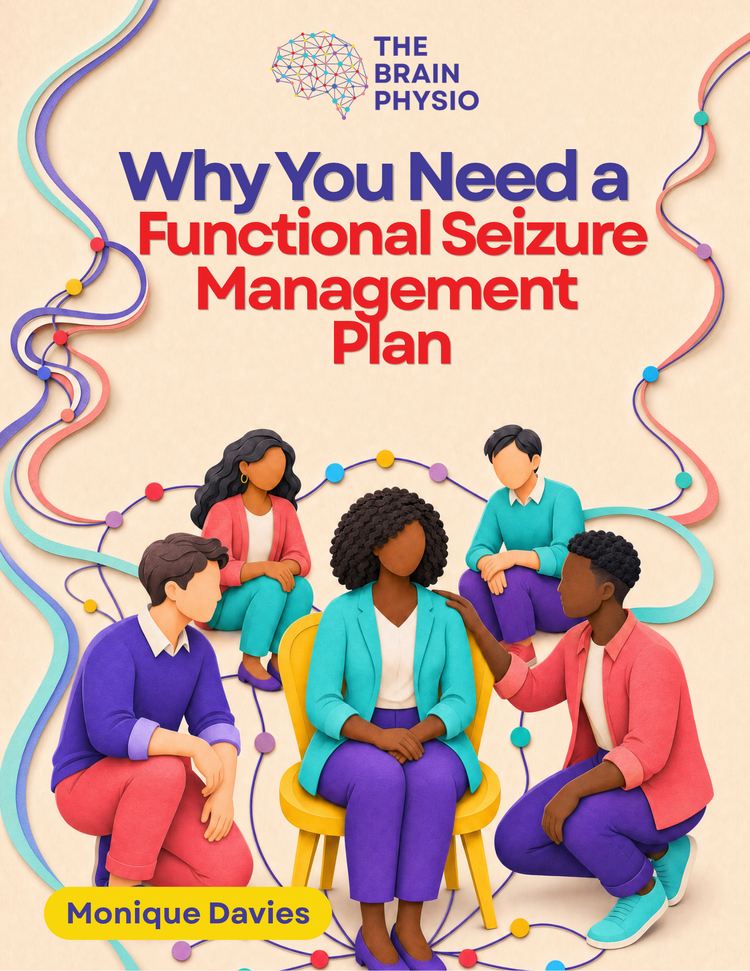
Free guide
Functional seizures:
management plan.
Monique Davies
The Brain Physio
Common questions
Does FND rehabilitation really work by telehealth?
Research so far is encouraging. Small studies have found similar improvement with physiotherapy by video and in person. See what the research says.
On a more personal note, Monique has helped many people with FND by telehealth over the years, with excellent results. If something needs to be done in person, she finds a local provider with the right skills and works with them, so you get the whole-person care you need. Read our Google reviews.
Can I start before I have a formal diagnosis?
Who can diagnose FND?
How long does recovery take?
What does it cost, and can I claim it?
Ready to start?
Book online, or email info@thebrainphysio.com.au and we'll get back to you.
In a medical emergency, or for a first seizure without a diagnosis, call 000. This page is general information, not medical advice.