
Brain health by telehealth, Australia-wide
Look after your brain health, at any age
Many of the things that shape your brain's long-term health are within your control. Find out which ones matter most for you, and what to do about them.
Is this for you?
You don't need a diagnosis to start. If any of these sound like you, a brain health consultation can help.
Someone you love has been diagnosed
A parent or partner has dementia, stroke or Parkinson's, and you want to know what you can do for your own brain.
You want to be proactive
You feel well and want a plan to look after your thinking, memory and movement as you age.
You're not sure where to start
There's so much advice out there. You want to know what matters most for you.
You feel foggy or flat
Brain fog, fatigue or just feeling a bit off, and you want to know what might help.
Why Monique started brain health
She kept seeing the same pattern before a diagnosis
Over more than a decade of working with people with stroke, Parkinson’s, dementia and Functional Neurological Disorder (FND), Monique heard the same story again and again.
- Stress at work
- No time to exercise
- A diet that slipped
- Poor sleep
- Then, a diagnosis
Many common neurological conditions are partly preventable, yet most people don’t link their lifestyle to dementia or stroke. Your risk isn’t set in stone, even if someone in your family has a neurological condition. Monique wants more people to know that, while there’s still time to act.
More than 1 in 3 people
live with a neurological condition. Neurological conditions are now the leading cause of illness and disability worldwide.
World Health Organization, 2024
Brain health is built across a lifetime
The 2024 Lancet Commission estimates that up to 45% of dementia cases could be prevented or delayed if 14 risk factors were addressed across the population. That's a population figure, not a personal guarantee. But most of these factors can be changed.
Source: Livingston G, et al. Dementia prevention, intervention, and care: 2024 report of the Lancet standing Commission. The Lancet, 2024. World Health Organization, Over 1 in 3 people affected by neurological conditions, 2024.
14 modifiable risk factors for dementia, including Alzheimer’s disease
From the 2024 Lancet Commission, grouped by the stage of life they matter most.
Early life
- Less education
Midlife
- Hearing loss
- High LDL cholesterol
- Depression
- Traumatic brain injury (including concussion)
- Physical inactivity
- Diabetes
- Smoking
- High blood pressure
- Obesity
- Excessive alcohol
Later life
- Social isolation
- Air pollution
- Untreated vision loss
Why start now
The choices you make today shape your brain for decades
Neurological conditions rarely come out of nowhere. Risk builds quietly over many years, and a lot of it comes from things you can change.
of the global burden of stroke is linked to risk factors that can be changed, such as high blood pressure, smoking and inactivity.
GBD 2021 Stroke Risk Factor Collaborators, 2024risk factors for dementia act in midlife, long before most people start thinking about dementia.
Livingston et al., 202423% women
of Parkinson's is linked to preventable risk factors, such as pesticide exposure and repeated head injuries.
Payami et al., 2023The good news
Your brain responds to small, steady changes
A year of regular walking grew the memory centre of the brain (the hippocampus) by about 2% in adults over 55, roughly reversing one to two years of age-related shrinkage.
Erickson et al., 2011People who followed the MIND diet most closely had thinking skills like someone 7.5 years younger.
Morris et al., 2015Sleep is when your brain takes out the rubbish. Waste, including beta-amyloid (a protein linked to Alzheimer’s disease), is cleared much faster during sleep.
Xie et al., 2013Higher levels of moderate to vigorous exercise are linked with a lower risk of developing Parkinson’s disease.
Fang et al., 2018Where to start
Monique’s big four for brain health
Exercise, sleep, diet and stress. Monique’s free guide shows you where to start with each one, and a consultation helps you work out which matters most for you.
Move
Sleep
Eat well
Stress less
Brain health education
Bring brain health to your workplace
Practical, evidence-informed talks for teams and staff wellbeing programs. Your people learn which risk factors they can change, and leave with small steps they can start straight away, at work and at home.
- Wellbeing weeks
- Lunch and learn sessions
- Team days and conferences
- EAP and staff wellbeing programs
Start with the basics
A free guide with simple, evidence-informed steps you can start this week, built around the big four for brain health, which are exercise, sleep, diet and stress. Straight to your inbox.
A self-paced online brain health course is coming soon. Register your interest
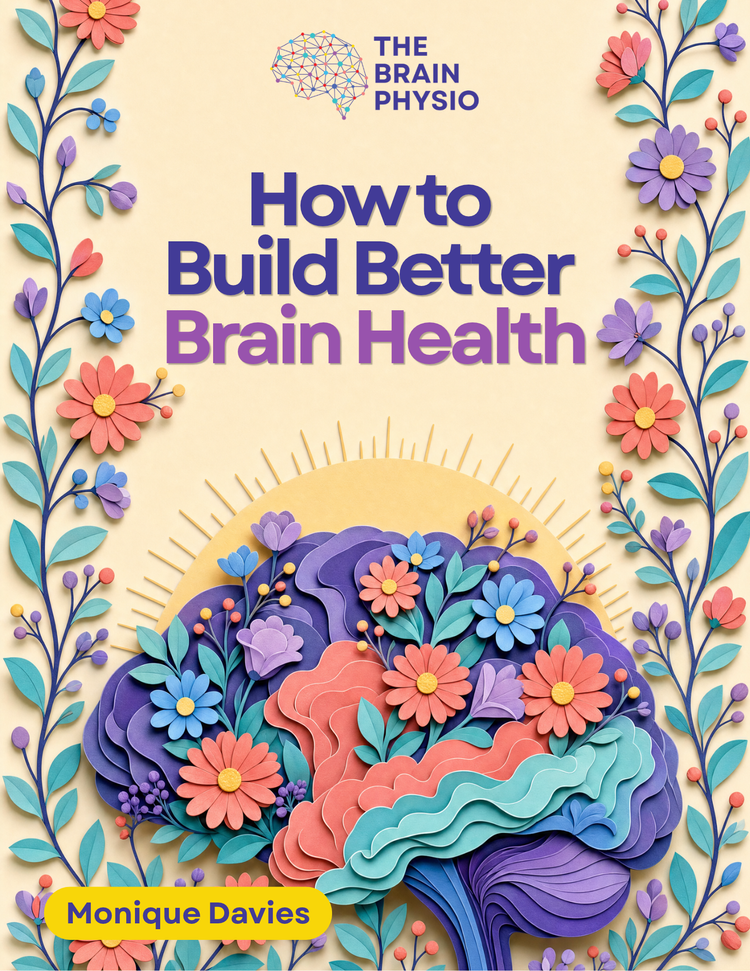
Free guide
How to Build Better Brain Health
Monique Davies
The Brain Physio
Common questions
Still unsure? Email info@thebrainphysio.com.au and we'll get back to you.
Do I need a referral?
Is this a memory assessment?
How does a video consultation work?
Is this suitable after a stroke or brain injury?
Can I claim a rebate?
Ready to start?
Book a talk for your workplace, book a one-on-one consultation, or email info@thebrainphysio.com.au. Need help with something else? Make an enquiry.